

Whenever talent management or succession planning comes up, the nine-box matrix tends to enter the discussion. And why not? This “magical” tool adds a little polish and prestige to the conversation and presents the results in a clear visual format. Everyone can see employees distributed across nine boxes along two axes: performance and potential.
But a clear picture does not necessarily mean the judgments behind it are accurate. The matrix may look simple, yet using it well requires a clear understanding of performance and potential, sound evidence, and experience in leading the discussion.
What Is the Nine-Box Matrix, and What Does It Offer?
The matrix combines three performance levels with three potential levels: low, medium, and high.
Where these levels intersect, we get nine boxes. An employee might have high performance and high potential, high performance and medium potential, or low performance alongside signs of high future potential. The figure below shows how combining the two axes determines the employee’s position.
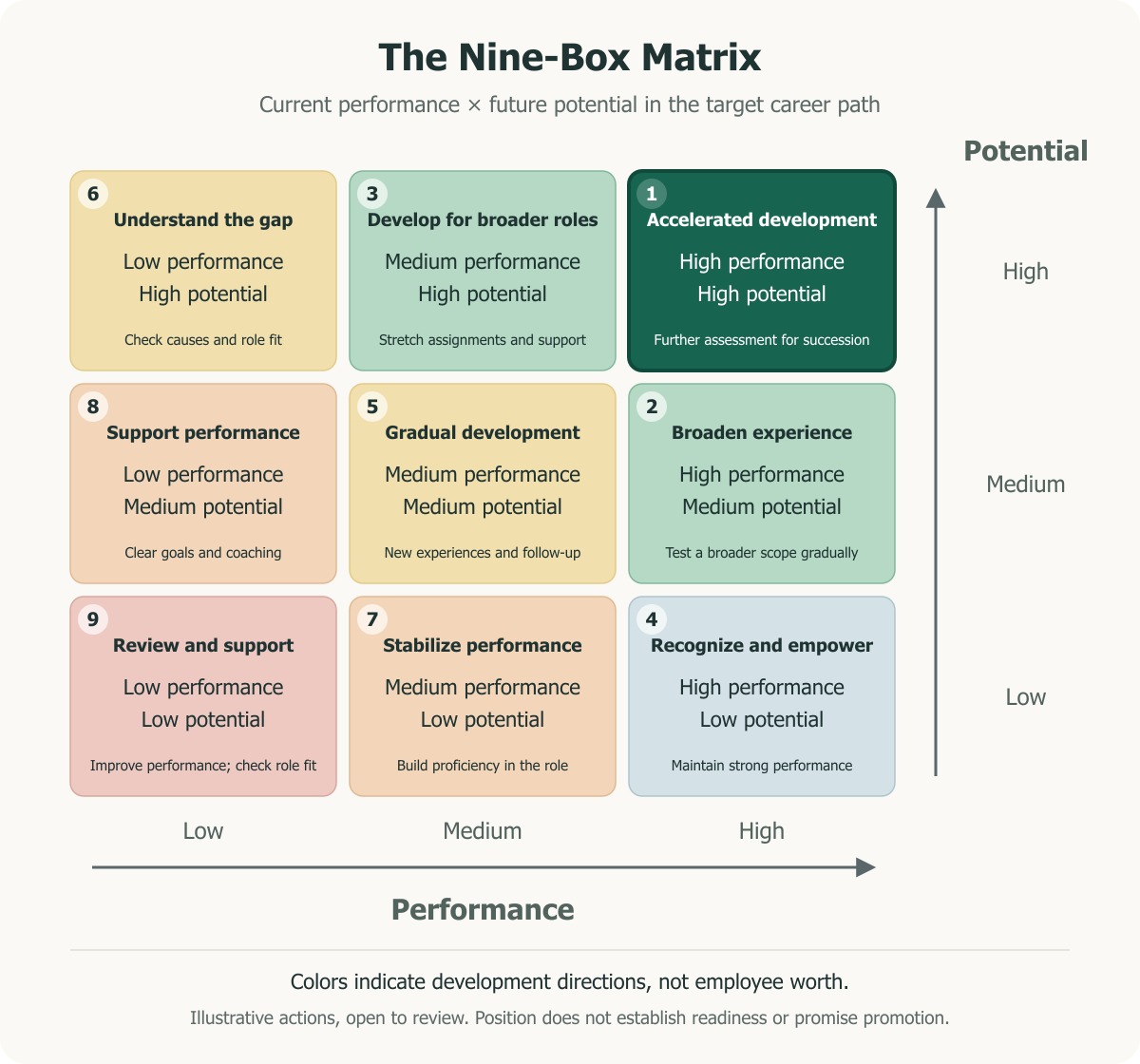
The most valuable part of the nine-box matrix is the discussion that takes place while reviewing the results, or even before that. How can an employee have high performance but low potential? Who is the employee with high potential but low performance? And what explains each situation?
This visual map allows talent management and the manager to see the group as a whole, rather than discuss each employee in isolation. It may reveal differences in assessment standards across departments and help the organization discuss how development opportunities are distributed and how much talent depth it has.
In my view, that is a positive outcome that makes the tool worth using, provided the discussion leads to a better understanding of employees and practical steps to develop them. If the organization cannot answer these questions and the questions that follow, what value does the matrix add?
Where Did the Matrix Come From?
One early example of the nine-box format is the GE–McKinsey matrix, which emerged in the early 1970s. It was not designed to assess employees. It was a business portfolio tool that helped the company compare its business units and decide where to invest.
One axis measured industry attractiveness; the other measured the business unit’s competitive strength. Depending on a unit’s position, the company could discuss investing in it, managing it selectively, or withdrawing from it.[1]
In human resources, the matrix is used to display employee assessments based on performance and future potential, rather than to assess business units.[2] However, the sources used for this article do not clearly establish when this use began or who developed it into its current form. We therefore cannot assign it a definite starting year or credit it to a particular person.
The Matrix Axes: Performance versus Potential
The performance axis considers what the employee has achieved in the recent past or is achieving now. The potential axis focuses on what the employee may be able to achieve in the future. This brings us to one of the matrix’s main challenges: the different kinds of evidence used to assess each axis.[3]
Why Is Potential Difficult to Assess?
Performance assessment often draws on documented results, achievements, and tasks that can be reviewed through work records and performance reviews. This makes its evidence easier to document and examine, although judgments can still be affected by the quality of goals and records and by the assessor’s biases.
Assessing potential means judging what an employee may be able to do in the future, perhaps in responsibilities they have not yet held. This makes the assessment more vulnerable to personal opinions and assumptions. One manager may see confidence in conversation as evidence of leadership potential, while another may associate potential with technical excellence or resemblance to leaders who have succeeded before. Without a clear definition of potential, each manager may be assessing something different.[4]
How Can We Make Potential Assessment More Objective?
Assessing potential has greater value and effectiveness when we know what we expect of the employee in the future, whether that means becoming a manager or moving into another role. We can then identify what success in that role requires, develop suitable questions and assessments, and look for evidence of the employee’s ability to grow toward it. This does not require a specific vacancy; knowing the type of responsibilities being considered is enough.
But when we use the matrix to explore the future potential of all employees, or a large group, there may be no single role against which to assess each person. In this case, it is more appropriate to identify a set of shared factors or competencies, such as learning from experience, dealing with complexity, and adapting to new responsibilities.
For each factor, we develop questions that seek examples of actual behavior wherever possible, along with clear criteria for assessing the answers. These should be adapted to the employee’s level and career path. We would not expect someone at the beginning of their career to provide the same examples as a department head.
The table below illustrates the assessment of three fictional employees. The questions are put to the manager, who rates how often the employee demonstrated the behavior during the review period: 1 — rarely, 2 — sometimes, 3 — often, taking account of their level and the opportunities available to observe them. Each factor receives one score, not each question. The manager is asked for a brief example supporting the rating so that the answer does not remain a personal impression.
| Employee | Learning from experienceWhen the employee receives feedback, do they adjust how they work in response?When facing a new situation, do they apply lessons from previous experience? | Dealing with complexityWhen information is incomplete or conflicting, do they check it and compare alternatives before deciding?When priorities conflict, do they weigh their importance and consequences? | Adapting to new responsibilitiesWhen given an unfamiliar responsibility, do they identify what they need to learn and work to acquire it?When task requirements change, do they adapt how they work? | Total out of 9 | Level in this example |
|---|---|---|---|---|---|
| Ahmed | 2 | 3 | 2 | 7 | Medium |
| Noura | 3 | 2 | 3 | 8 | High |
| Khalid | 1 | 2 | 1 | 4 | Low |
In this example only, we give the factors equal weight and add their scores to determine a level: 3–4 low, 5–7 medium, 8–9 high. The names, scores, and thresholds are fictional and illustrate the approach; they are not a research-validated standard. Before actual use, the organization needs to test whether the factors, weights, and thresholds fit the purpose of the assessment, and discuss the evidence before confirming the result on the potential axis. Adding the scores does not, by itself, establish that the judgment is sound.
If there has been no opportunity to observe a factor, the manager selects “No opportunity to observe” rather than assigning a “rarely” score. The final result is deferred until the assessment can be completed. A score should also not be accepted without sufficient supporting evidence.
This gives us a consistent approach that helps reduce the influence of personal impressions. When a specific future opportunity becomes clear, we supplement the assessment against its requirements.
Does High Potential Mean Readiness?
A high potential rating or a higher position in the matrix does not, of course, mean that an employee is ready now. Readiness relates to a specific role, specific requirements, and a specific point in time. We may see strong future potential, while the employee still needs experience managing a budget, leading a larger team, or working in another area before becoming ready for a particular position.
The nine-box matrix is a map for discussion, not a final judgment on an employee or a guaranteed prediction of their future.
Who Are High-Potential Employees (HiPos), and How Do They Relate to the Matrix?
HiPo is short for High-Potential Employee: someone the organization currently considers to have high future potential, according to its definition of the career path and responsibilities in question.
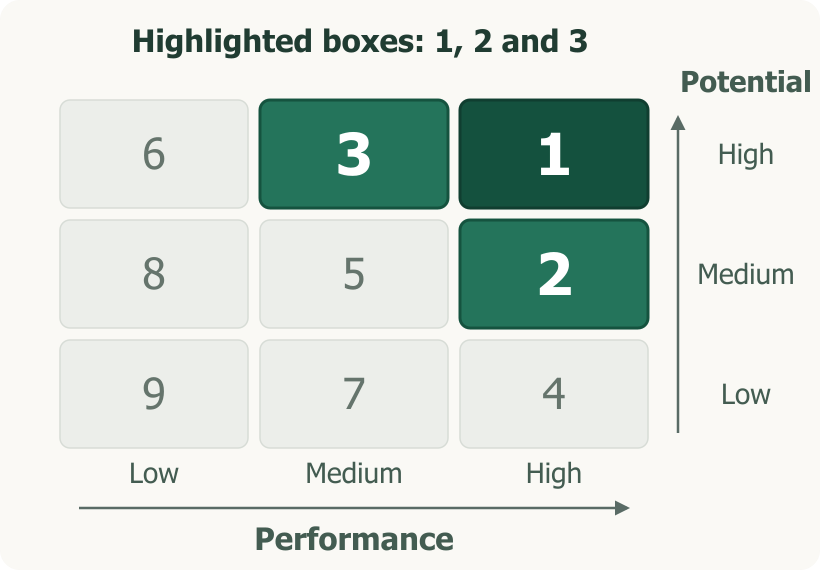
Some organizations use the top-right box to identify HiPos, while others extend the category across more than one box, often including the three boxes near the top-right corner: boxes 1, 2, and 3 under the numbering used here.
Is There a Fixed Percentage of HiPos?
There is no single agreed percentage of high-potential employees. Some sources report percentages observed in particular organizations, while some practitioners suggest indicative ranges. These vary with the definition of potential and the population being assessed. They do not establish an ideal percentage that applies to every organization.[5][2]
Nor does the nine-box matrix prescribe a percentage for this group or for any individual box. An organization can use reference figures to review its results while basing decisions on evidence and future needs. It should also distinguish between classifying an employee as high potential and selecting them for a development program with limited places. Setting a fixed number for each category in advance adds a forced distribution to the process; it is not a requirement of using the matrix.
Are There Better Tools than the Nine-Box Matrix?
A tool’s effectiveness depends on what we need to know. The matrix is an excellent visual way to display and organize assessment results and bring them into a discussion. But it is not a complete tool for measuring potential on its own. If our aim is simply to identify high-performing employees, we can begin with work results and the performance review process. If we want to identify high-potential employees more accurately, we need additional evidence about what they may be able to do in the future.
When the aim is to assess an employee’s suitability for specific responsibilities, work simulations and assessment centers linked to those responsibilities may be more suitable for gathering evidence than relying only on the manager’s judgment and the employee’s position in the matrix. But they require appropriate design, trained assessors, time, and money. They do not guarantee future success.[6]
We can also combine more than one tool or method to support decisions. We are not always comparing tools that do the same job: assessment tools gather evidence, while the matrix helps organize it and discuss what to do with it. That is why I do not see one tool as the best in every situation. The choice follows the purpose, the group being assessed, and the quality of evidence required.
Do We Need a Nine-Box Matrix to Build a Succession Plan?
The nine-box matrix appears so often in succession planning discussions that it can seem like a required step. But this connection is not a requirement; the two serve different purposes.
The matrix helps review employees according to their performance and potential. Its results can contribute to talent pools, including high-potential talent pools. These may provide candidates for succession plans, but selecting those candidates requires further assessment against the requirements of the target roles and their readiness to take them on.[7][5]
A succession plan focuses on critical roles: who could fill them, when, and what development would they need? An organization can answer these questions and build its plan without using a nine-box matrix. It can also use the matrix to review talent and guide development without linking every employee to a specific position in a succession plan.
The matrix can support succession planning, but having one does not require having the other.
How Do We Prepare for and Run Nine-Box Discussions?
Explain the Purpose to Managers
Explaining the purpose of the matrix is one of the most important preparation steps, and it deserves sufficient time and attention. It should not be treated as a formality before placing names in boxes.
We need to make clear to managers that these sessions are not for repeating performance reviews or making promotion or reward decisions. The main purpose in this application is to build a talent map, understand employees across the department and the company more fully, and identify their development needs and opportunities. A clear purpose helps the manager discuss employees and the evidence about them, instead of focusing on defending their positions in the matrix.
Prepare Performance Data and Assess Potential
After explaining the purpose, we introduce the two axes and how we will work with them. HR prepares performance review data for the agreed period and provides it to managers, explaining its source and the criteria behind the performance levels. For potential assessment, we need managers’ knowledge of their employees and their experience of how those employees work, learn, and handle responsibilities.
We explain the approach, factors, questions, and assessment criteria, as in the earlier example. Managers participate from this stage in discussing the factors and applying them to their employees, providing examples and evidence for each rating. We do not assume that high performance alone proves high potential; each axis needs its own evidence.
Build and Calibrate the Initial Picture
Combining the performance data and potential ratings produces an initial matrix for the department. We review it with managers in a calibration session: were the questions understood in the same way? Does the evidence support the answers? Is information missing, or is there a reason to revise a rating?
Agreement among participants is not enough. We also examine the influence of personal impressions and unequal opportunities: have employees had comparable opportunities to demonstrate their abilities? Are we assessing documented behavior, or have we been influenced by an employee’s confidence in speaking or closeness to the manager? The reasons for each rating and any missing information are recorded. A lack of information must not automatically become a low rating.
After reviewing departmental matrices, we can combine them at company level and compare how standards have been applied. If one department places most employees in the upper boxes while another uses stricter standards, we review the reasons and evidence. We do not impose a fixed number in each box simply to make the distributions look alike.
Assessment Tests: Making Results More Objective
At this stage, the initial results can be supported by standardized professional assessments, such as cognitive ability tests[8] and work-related personality measures.[9] These add another source of evidence alongside the manager’s assessment and can help make the process more objective. But not every test is suitable for this purpose. We need to establish that it measures what we want to measure, produces consistent results, and is appropriate for the employees and the responsibilities being considered.[10]
We review test results alongside the manager’s observations and examples from the employee’s work. If they differ from the initial results, we investigate why and what further information is needed before confirming the result. The aim is neither to use a test to confirm the manager’s opinion nor to replace that opinion with a test score. It is to reach conclusions supported by a broader set of evidence.
Put the Map to Work through Development and Follow-Up
After calibration and reviewing the assessment results used in the process, the work that gives the matrix its value begins. We do not want it to remain an exercise on paper. It should help us ask useful questions and take practical steps with employees.
If an employee has high potential but low performance, we ask: what is holding their performance back? Are the role’s requirements clear? Do they need support or a particular kind of experience, or is the role a poor fit? If both performance and assessed potential are low, we look into the reasons and what guidance, training, or changes to the work might help, rather than merely placing the employee in a low box.
We turn the discussion into a clear plan for each case, specifying the action, the support the organization will provide, what is expected of the employee, who is responsible for follow-up, and when progress will be reviewed. The aim is to improve performance, develop capabilities, and better match responsibilities to abilities, not to move the employee to a higher box for its own sake. Meaningful development can take place without a change in matrix position.
During follow-up, we ask: has performance improved? Has new evidence of potential emerged? Were the development opportunities appropriate? The judgment remains tied to a particular time and context and is reviewed as performance changes and new information becomes available.
Limits on Using the Results
When the matrix is applied across the company, classifying an employee as high potential is not enough, on its own, to make a final promotion or reward decision. For a specific promotion, we need to define the future role and what success requires, then assess the employee’s suitability and readiness. Rewards should follow the organization’s established criteria and what the employee has achieved, not their position in the matrix alone.
Should We Tell Employees Where They Sit in the Matrix?
Every employee should understand how the organization views their performance, their strengths, what they need to develop, and the paths available to them. Naming their box alone does not provide that transparency. What matters is that they understand the judgment and what follows from it.
If the organization decides to tell an employee that they have been identified as high potential, we explain what we appreciate in their performance and contribution, and what evidence currently suggests they could handle broader or more complex responsibilities. We explain that we want to help them develop these capabilities and maintain their strengths.
Expectations should be clear from the start: this classification is not a promise of promotion, and their position in the matrix is not permanent. It is a current judgment that can be reviewed in light of their performance, how they work and learn, and any new evidence. We clarify what we expect from them in the development plan and, in return, what opportunities, support, and feedback we will provide, and when we will review progress together.
Recognition without clear follow-through can raise expectations and then disappoint the employee. A study of employees formally designated as talent found that, for some, initially positive reactions gave way to frustration and uncertainty when the designation was not followed by opportunities or tangible steps.[11] Telling an employee should therefore be linked to what the organization can actually provide, not open-ended expectations.
An employee who has not been included in the HiPo group should not be told that they are “not outstanding” or “have little potential.” That is not what the matrix establishes. It is better to discuss their performance, value in their current role, aspirations, and the capabilities or experiences they need to pursue other paths. Basic learning opportunities should also remain available to employees generally; identifying a small group should not mean neglecting everyone else.
References
- McKinsey & Company (2008). Enduring Ideas: The GE–McKinsey nine-box matrix.
- The Talent Strategy Group (2025). 2025 Potential Report.
- Silzer, R., & Church, A. H. (2009). The Pearls and Perils of Identifying Potential. Industrial and Organizational Psychology, 2(4), 377–412.
- Corporate Research Forum (2025). Assessing Potential. Rob Briner, Work Psychology Series.
- Silzer, R., & Church, A. H. (2010). Identifying and Assessing High-Potential Talent: Current Organizational Practices. In Strategy-Driven Talent Management, Chapter 5, pp. 213–279.
- U.S. Office of Personnel Management (OPM). Assessment Centers.
- CIPD (2025). Succession planning. Updated 5 December 2025.
- U.S. Office of Personnel Management (OPM). Cognitive Ability Tests.
- U.S. Office of Personnel Management (OPM). Personality Tests.
- U.S. Office of Personnel Management (OPM). Assessment Glossary.
- Tyskbo, D., & Wikhamn, W. (2023). Talent designation as a mixed blessing: Short- and long-term employee reactions to talent status. Human Resource Management Journal, 33(3), 683–701. First published online 30 November 2022.